

you turned a mistake into a whole personality and i'm concerned
or: what guilt is, what shame is, and why you need to stop confusing them

sth to think about
last week i wrote about play, and how most of us stopped doing silly, delightful, completely pointless things somewhere on the way to becoming functional adults. and while i was writing it, i kept circling back to the same word: shame. shame is the thing standing between a lot of us and the plushie, the cartoon, the skipping down the street just because.
then i thought about it more and realized shame is doing a LOT more damage than just keeping us away from the fun stuff.
so let’s talk about it properly. specifically, let’s talk about shame vs guilt, which get used interchangeably by basically everyone (including me, for about twenty years), but actually do completely different jobs inside your head.
understanding the difference changed how i relate to myself big time. that sounds dramatic, i know. and it honestly kinda is, ha.
it’s a small distinction, but it’s SO incredibly powerful!
let’s dig in.
okay so what’s the actual difference
it comes down to what the feeling is pointing at.
🧚 guilt points at a behavior → “i did something bad.” it’s specific, it has edges, and it comes with an implied next step: fix it, apologize, do it differently.
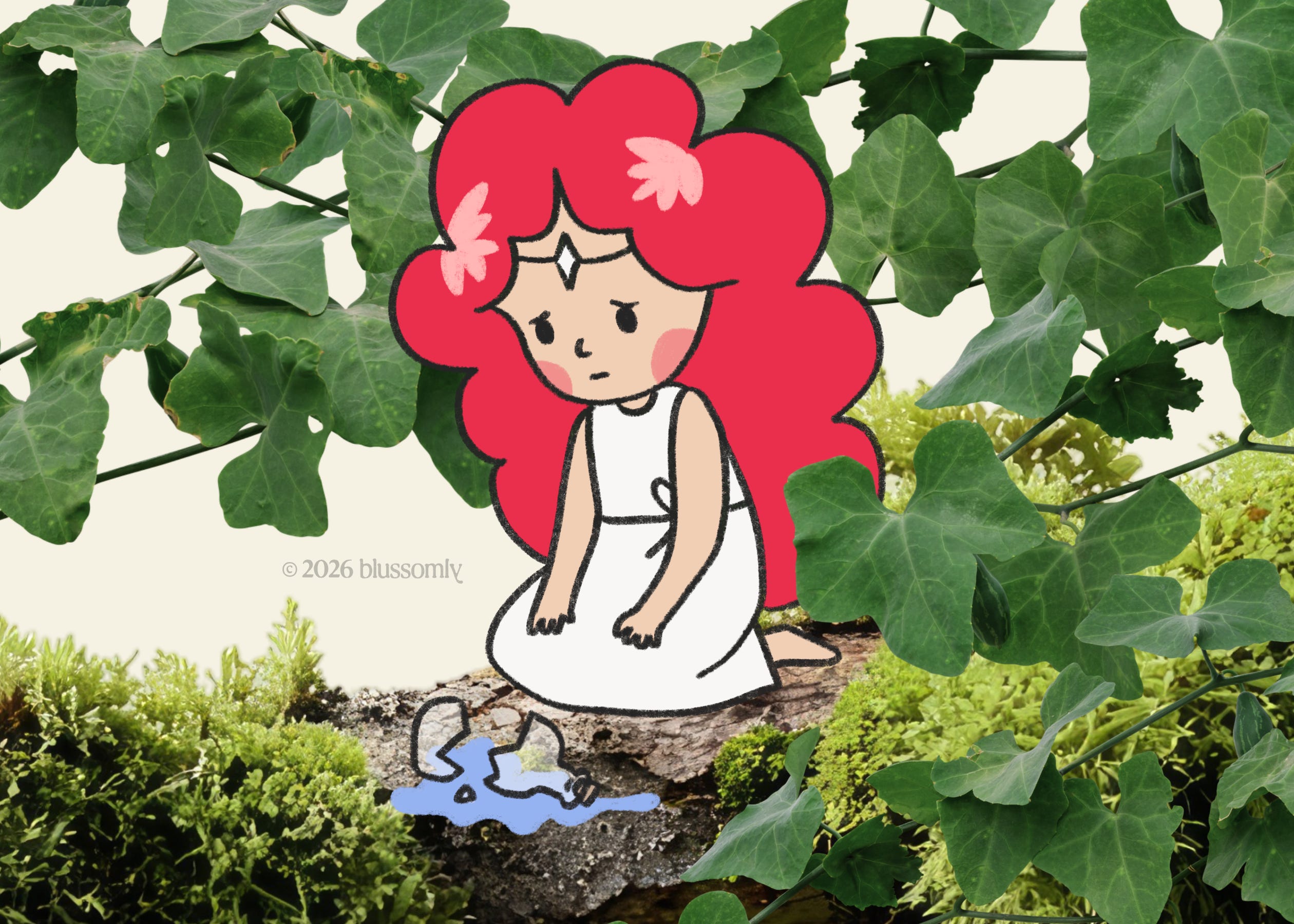
🧚 shame points at you → “i am bad.” there are no edges, there’s no next step, and there’s nowhere to go with it except inward.
it sounds small on paper. but in practice, these two produce opposite behaviors.
let me explain.
guilt makes you reach out to the person. shame makes you leave them on read for days (or weeks, let’s be real) because you can’t face what you think they now know about you.
guilt makes you own the mistake at work. shame makes you get defensive, or overexplain, or start avoiding the person who pointed it out.
→ guilt says “i handled that badly.”
→ shame says “i’m just bad at relationships/all of this/life/being a decent person”, which is a muuuch bigger claim, but presented with much less evidence.
the thing is, your brain rarely announces when it makes the switch! which usually happens through one small word getting smuggled into the sentence:
“i was short with her” becomes “i’m ALWAYS short with people”
“i missed that deadline” becomes “i’m JUST bad at this job”
“i didn’t handle that conversation well” becomes “i’m THE KIND OF PERSON who ruins things”
always. just. the kind of person who. those are the smuggling words. once one of them shows up, you’ve left guilt behind and you’re in shame, and the useful part of the feeling is gone.
but wait, isn’t guilt bad?
yes okay, we need to deal with this, bc i’ve now spent several paragraphs describing guilt like it’s a helpful little friend and that probably clashes with everything you’ve absorbed about it.
most of us grew up learning guilt was something to get rid of. guilt-tripping is manipulative (it is). guilt about your body, your rest, your boundaries, your money, your ambition, that’s all stuff we’ve collectively worked hard to unlearn (correctly!). so calling guilt useful feels off.
there’s two separations i feel like are worth making here.
first: guilt-tripping and guilt are different things. guilt-tripping is something a person does TO you, on purpose, to get you to do what they want. the guilt i’m describing is an internal signal that fires when your own behavior has drifted from your own values. one is a tool of manipulation, and the other is your conscience doing its actual job.
second, and this is the more important one: not all guilt is healthy guilt. psychologists distinguish between guilt that’s proportionate and guilt that isn’t, and the unhealthy version tends to look like this:
guilt about things that were never in your control (someone else’s mood, an outcome you couldn’t have changed)
guilt that keeps running long after you’ve repaired the thing
guilt about ordinary human needs, like resting, saying no, or wanting things
guilt with no possible action attached to it, so it just sits there
Tangney’s research (more on that below) is careful about this too, and she talks specifically about “shame-free guilt”, meaning guilt that hasn’t collapsed into a verdict about the self. THAT’S the version with all the good outcomes attached. the chronic, unfixable, permanently-on kind is usually actually shame (Tangney & Dearing, 2002).
so the working test: if your guilt has a specific behavior attached and a possible next action (or several), it’s probably healthy guilt. if it has no leeway and no exit, something else is going on.
what the research says
this distinction is a helpful self-help thing, sure. but it also happens to be one of the most studied areas in moral psychology! the researcher who built most of that body of work is June Price Tangney, and her findings are consistent across a genuinely wide range of studies:
shame-proneness is associated with higher rates of depression, anxiety, and psychological symptoms across basically every population studied (Tangney & Dearing, 2002; Tangney et al., 2011)
shame-prone people are LESS empathetic toward others, not more, which surprised me the first time i read it (Tangney, 1991; Tangney, 1995)
shame is strongly linked to anger, hostility, and externalizing blame. when shame becomes unbearable, people frequently lash out instead of withdrawing (Tangney et al., 1996)
guilt-proneness goes the other direction entirely: more empathy, more willingness to take responsibility, less destructive behavior (Tangney, 1991; Tangney et al., 1996)
please keep in mind that this research is correlational. shame and these outcomes travel in the same direction reliably, but nobody has proven shame CAUSES them. still, when a pattern shows up that consistently across many populations, it’s telling you something.
the finding that reorganized my thinking, though, is the empathy one. we tend to assume that feeling terrible about yourself means you’re taking the moral thing seriously. the data suggests the opposite: when you’re drowning in shame, all your attention goes to you and your own awfulness, and there’s nothing left over for the person you actually hurt.
which means shame doesn’t just feel bad. it makes you worse at the exact thing you’re feeling bad about.
the stoic angle
the Stoics cared enormously about character. but character, in their framework, was something you PRACTICED, not something you were issued at birth and then either lived up to or failed. every action was a rep. one bad rep couldn’t define you, because the next one was already coming.
and they had this useful view of wrongdoing: they saw vice as ignorance rather than identity. people do bad things because they’ve misunderstood what’s actually good, not because they’re built wrong or simply are bad people overall. which turns the response from “there’s something fundamentally wrong with me” into “i still have something to learn”.
those two hold SUCH a different emotional weight?!
“If someone can prove me wrong and show me my mistake in any thought or action, I shall gladly change. I seek the truth, which never harmed anyone: the harm is to persist in one’s own self-deception and ignorance.” — Marcus Aurelius
GLADLY. he says gladly! this is a man running an empire, saying that being shown he’s wrong is good news (modern politicians could never). and his reasoning is so clean: the mistake itself was never the worst part of it all; staying inside it was.
and then there’s Seneca, who had a whole nightly ritual for this:
“When the light has been taken away and my wife has fallen silent, aware of the habit that’s now mine, I examine my entire day and go back over what I’ve done and said, hiding nothing from myself, passing nothing by. I have nothing to fear from my errors when I can say: ‘See that you do not do this anymore. For the moment, I excuse you.’”
— Seneca
read that last line again. for the moment, i excuse you. (why does this make me emotional)
he goes through the whole day, hides nothing, and names every place he fell short. and then he lets himself off the hook for the night (!!). the honesty and the self-compassion arrive pretty much in the same breath, how awesome (and modern) is that.
THAT is what accountability without self-hatred truly looks like. and it’s a very different thing from the 3am review most of us run, which is all examination, a lot of scolding, and no excusing.
so the reframe i’d hand you is this:
after a mistake, the question “what does this say about me?” (which your brain asks and answers without you even noticing, btw) has no useful answer and no exit. try a conscious “what can i practice now?” instead. it points forward, it has an obvious next action, and it treats you as someone who is still in the process of becoming, which you are, obviously, ALWAYS.
don’t try to get rid of your guilt. guilt is your conscience pointing at your values. protect it from turning into shame, though, which is your inner critic seducing your conscience and permanently damaging your sense of self.
🌻 remember: healthy guilt helps you grow. shame convinces you you’re beyond growing.
sth to learn from
i’m gonna be real with you; i confused these two for most of my life and had no idea what it was costing me.
every mistake i made went straight past the behavior and landed on my identity. i didn’t handle a conversation badly, i WAS a bad communicator. i didn’t have an off week at work, i WAS someone who couldn’t be relied on. i couldn’t throw far in PE class, which must have meant i simply WAS an unathletic person overall. and once a mistake became a fact about me, there was nothing to do with it except carry it around and feel awful.
what i couldn’t see back then is how effing greedy shame is?! it doesn’t stay in the room where it started, it clings to you, laughing evilly straight into your ear, getting louder and louder. i’d mess something up as a friend, and within about ten minutes my brain had extended that ruling to every other role i have. student, daughter, partner, person. all of it, revoked, on the basis of one thing.
which is such bad math?? yes, i can be a bad friend sometimes. genuinely, i can. that is a true and specific thing i can work on. but it says approximately nothing about whether i’m a good student, and shame does not care, shame just files it all under the same verdict and hands you the sentence. in my case (sorry if this is dark), that sentence used to be something like “i’m worthless and shitty and bad and why would anyone even like me”.
(and to be clear, i’m not saying this to let myself off! being a bad friend sometimes is a real thing that should be worked on. i’m saying we make it so much harder to actually fix by first burying it under a pile of self-loathing so heavy we can’t move.)
the thing that changed it was learning that a mistake is just a mistake (isn’t that revolutionary lmao).
what really surprised me was that admitting it out loud is what releases you. i used to think admitting a mistake would confirm the terrible thing i suspected about myself. but the opposite happened! naming it clearly, made it a thing i DID instead of a thing i AM. it helped me accept that this is what happened, and cleared the path forward; to do better.
that Marcus quote gets me every time bc of the gladly. being shown where you went wrong is a gift, and shame is what makes it feel like an attack instead.
one more thing: people telling you “but you’re not a bad person” does almost nothing if you don’t believe it. i’ve had lovely people reassure me and watched it bounce straight off. bc my shame convinced me they were lying to be nice. the release has to come from inside, and weirdly, the way in is through the accountability, not around it. you name your mistake, you make a plan for fixing/mending, and suddenly this one thing stops being the conclusive evidence of your entire self.
sth to practice
the Seneca review 🌌
Seneca did this every night. we’re doing a slightly less roman version. it’s three questions, written down (please, to make it explicit), and takes five minutes at the end of the day:
1️⃣ what specifically did i do or say today that i’d do differently?
name the behavior. “i snapped at her.” “i avoided replying.” “i went in unprepared.” the behavior, not the interpretation. try to be objective and descriptive here.
2️⃣ what will i actually do differently next time?
write down one concrete thing. this is where the guilt turns into something useful instead of something you just marinate in.
3️⃣ what do i excuse myself for tonight?
pick one thing you handled imperfectly and put it down. out loud if you’re feeling brave: for the moment, i excuse myself / let it go. this does not mean i’m a bad person overall. (yes, it feels weird. Seneca did it anyway, and he had a much harder life than most of us.)
💡 the whole practice lives or dies on the language you use in question one. write “i was talking over him,” not “i’m impossible to live with.” write “i didn’t prepare enough,” not “i’m a fraud.”
sth to ask yourself
here’s your journal prompt for this week:
“finish these two sentences honestly: ‘i did ___.’ and then: ‘therefore i am ___.’ look at that second sentence. is it true, or is it shame doing math it isn’t qualified to do?”
(most of the time the first sentence is accurate and the second one is straight-up fiction. shame would be an excellent telenovela writer…)
sth to save
here’s this week’s reminder. save it as your lockscreen, or keep it in your camera roll for when you need it.
did this resonate?
if this one hit a nerve, you’d probably like the stoic girl collective. it’s my community for deep feelers and overthinkers, where we go through a new theme every month with proper educational input, reflection prompts, and downloadable resources you can actually use.
🫂 the part i’d point you to this week, though, is the other women. there’s something specific that happens when you say the slightly embarrassing thing out loud and other people go “oh my gosh, same.” a lot of what we think is a personal failing turns out to be a veeery common human experience. you can join us here.
🧸 and if you’d rather work through things on your own first, my workbook the stoic girl starter pack is here.
until next week,
with love,
luise
M.Sc. Psychology | Founder of Blussomly
References:
Tangney, J. P. (1991). Moral affect: The good, the bad, and the ugly. Journal of Personality and Social Psychology, 61(4), 598–607. https://doi.org/10.1037/0022-3514.61.4.598
Tangney, J. P. (1995). Shame and guilt in interpersonal relationships. In J. P. Tangney & K. W. Fischer (Eds.), Self-conscious emotions: The psychology of shame, guilt, embarrassment, and pride (pp. 114–139). Guilford Press.
Tangney, J. P., Wagner, P. E., Hill-Barlow, D., Marschall, D. E., & Gramzow, R. (1996). Relation of shame and guilt to constructive versus destructive responses to anger across the lifespan. Journal of Personality and Social Psychology, 70(4), 797–809. https://doi.org/10.1037/0022-3514.70.4.797
Tangney, J. P., & Dearing, R. L. (2002). Shame and guilt. Guilford Press.
Tangney, J. P., Stuewig, J., Mashek, D., & Hastings, M. (2011). Assessing jail inmates’ proneness to shame and guilt: Feeling bad about the behavior or the self? Criminal Justice and Behavior, 38(7), 710–734. https://doi.org/10.1177/0093854811405762
so well explained Luise!! this piece made me wonder whether shame can also function as a protective mechanism against the discomfort of change. if we internalize a mistake as part of who we are, I wonder if that sometimes protects us from the vulnerability of confronting it, repairing it, and growing from it. because then we don't have to grapple with the tough questions like "why did i act that way, where is that coming from", etc. in some ways, it's almost easier to believe "this is who i am, i am a bad person" than it is to sit with the discomfort of change. wondering what you think of that ❤️
I think shame also makes people become more self-centered, since you make everything about you, so you will be focusing on yourself, and as mentioned in the essay, shame doesn't allow you to change, but it stops you. So eventually it becomes a loop that it's hard for you to come out.