

how to find your purpose
or: why "find" might be the wrong word entirely

sth to think about
let’s talk about the question that has probably ruined more random wednesday afternoons than basically any other:
“what’s my purpose?”
i'm sure you’ve sat with this one before. maybe…
…scrolling through someone else’s perfectly aligned career timeline and wondering why your own life looks like an unfinished, too colorful patchwork quilt?
…in the middle of what's supposed to be a serene yoga practice, meditation session, or nature walk; suddenly hit with “but what am i actually doing with my life”?
…at 11pm questioning every choice you’ve ever made and not arriving at any conclusions, just more questions?
yeah. i've been there, too.
and to be completely honest, i believe the cultural messaging around purpose has gotten a little out of hand. we’ve been sold this idea that everyone has one true calling waiting to be discovered, that meaning is a thing you go out and find, and that until you find it, you’re somehow incomplete or behind or doing life wrong.
there's ikigai diagrams everywhere. “what’s your why?” workshops. instagram posts of people who quit corporate to become full-time bee farmers and now their lives have ✨meaning✨.
and listen, i'm not trying to shade any of that! finding work and a path you love is a wonderful thing. but it’s not the only source of meaning. and the way most of us have been framing the whole purpose conversation has been making us miserable, honestly.
🧚♀️ quick PERMA reminder for anyone who’s just joining: this newsletter is part of an ongoing series on Seligman’s (2011) PERMA model: a framework from positive psychology for what actually makes a life feel good. so far we’ve covered P — positive emotions, E — engagement, and R — relationships. this week is M for meaning. let's dive in!
🧠 what meaning actually means (the three-part version)
okay so before we go further, meaning is one of those words that gets thrown around without anyone defining it. researchers in this area usually break it down into three components, all of which work together (Martela & Steger, 2016):
🌷 coherence — your life makes sense to you. there’s a recognizable thread running through your experiences, your choices, who you’ve been and who you’re becoming. you can tell yourself a story about your life that feels like yours, even when things are hard.
🌷 purpose — you have direction. there are things you’re working towards, even if they’re small or evolving. you have a sense of “this is where i’m going” or at least “this is the next thing i’m trying.”
🌷 mattering / contribution / significance— your existence has weight beyond just yourself. you contribute to something or someone. you matter to people, your work matters in some way, your presence makes a difference (even a small one).
most of the popular content out there focuses pretty obsessively on the second point: purpose. but the research actually points to contribution as the strongest predictor of long-term wellbeing (Wrzesniewski et al., 1997; Steger et al., 2008). and then coherence is what makes the whole thing feel stable rather than chaotic when life throws you off track.
let’s look at what each of these looks like in practice bc i think it’ll help understanding the trichotomy better.
🌷 coherence: when it’s missing vs. when it’s present
coherence is the one a lot of people struggle with but don’t have a word for. when it’s missing, life feels scattered. you can’t really explain to yourself why you’ve made the choices you have. your past and present feel like they belong to different people. you’ll catch yourself thinking “how did i even get here” or “i don’t recognize my own life anymore.”
when it’s present, you can look at where you’ve been (even the chaotic parts, even the choices that didn’t work out) and recognize yourself in it. you can name the through-line. that said, life doesn’t have to make perfect sense, that's not what coherence asks for; but it has to feel recognizably yours.
🏛️ the stoic practice of self-examination (like Seneca’s evening review, or Marcus’s journaling) was essentially a coherence-building exercise: they were making meaning of their lives as they were living them, not waiting for some grand retrospective at the end.
🌷 purpose: having direction
purpose can look like a project you’re working on, a skill you’re building, a value you’re trying to live more fully, a person you’re trying to become… it doesn’t have to be a five-year plan with quarterly milestones (overwhelming much). it can be as simple as “i want to become more patient this year” or “i’m building toward leaving this job in 18 months” or “i want to write something real one day.”
and one thing worth noting: purpose isn't usually a singular, predetermined calling. it tends to shift and evolve over time, and what it looks like at 25 can be very different from what it looks like at 55.
🌷 mattering: contribution beyond yourself
i know what you think: “‘mattering,’ that sounds like you have to be famous, important, or universally significant, right?” luckily, no. mattering speaks to your existence having weight outside of just your own internal experience. you contribute. you’re useful for something. someone or something is better because you exist.
i wanna stay on this one for a bit bc i think it's pretty overlooked, but actually super useful.
🧠 the contribution research is kind of wild
i remember sitting in our lecture hall at uni, listening to one of my professors talk about life satisfaction across professions. he said something that genuinely changed how i think about meaning: one of the groups that consistently reports the highest life satisfaction across studies is people in caring professions, like nurses, social workers, and teachers. even when the work itself is hard, bc these obviously aren't easy jobs. this is well-supported in the meaning research: people whose work has clear prosocial impact tend to experience higher sense of purpose and life satisfaction (Wrzesniewski et al., 1997; Grant, 2007).
why? bc they’re contributing to other people, every day, in tangible ways. they don’t spend their days focused on themselves. their attention is structurally directed outward.
and there’s a related body of research showing that excessive self-focus correlates with worse mental health outcomes, particularly depression: rumination and self-preoccupation tend to deepen the spiral rather than help (Mor & Winquist, 2002). while other-directed activity (caring for someone, contributing to something, even small acts of focused care) can interrupt that spiral and shift how you feel surprisingly fast.
i want to be careful with this one bc i don’t want it to register as “become a nurse” or “depression is fixed by helping others.” that would be reductive and not quite right. what i’m saying is: contribution outward, in whatever form it takes, is one of the most reliable sources of meaning we have. and one of the easiest things to forget when you’re feeling lost or stuck in your own head.
the stoic angle
okay so here’s where the stoic reframe completely changes things.
most popular wellness content treats purpose like it’s a destination. it's out there somewhere, waiting for you to discover it, perfectly matched to your specific soul. and once you find it, your life makes sense.
the Stoics would push back on this (what a relief, right?). their take:
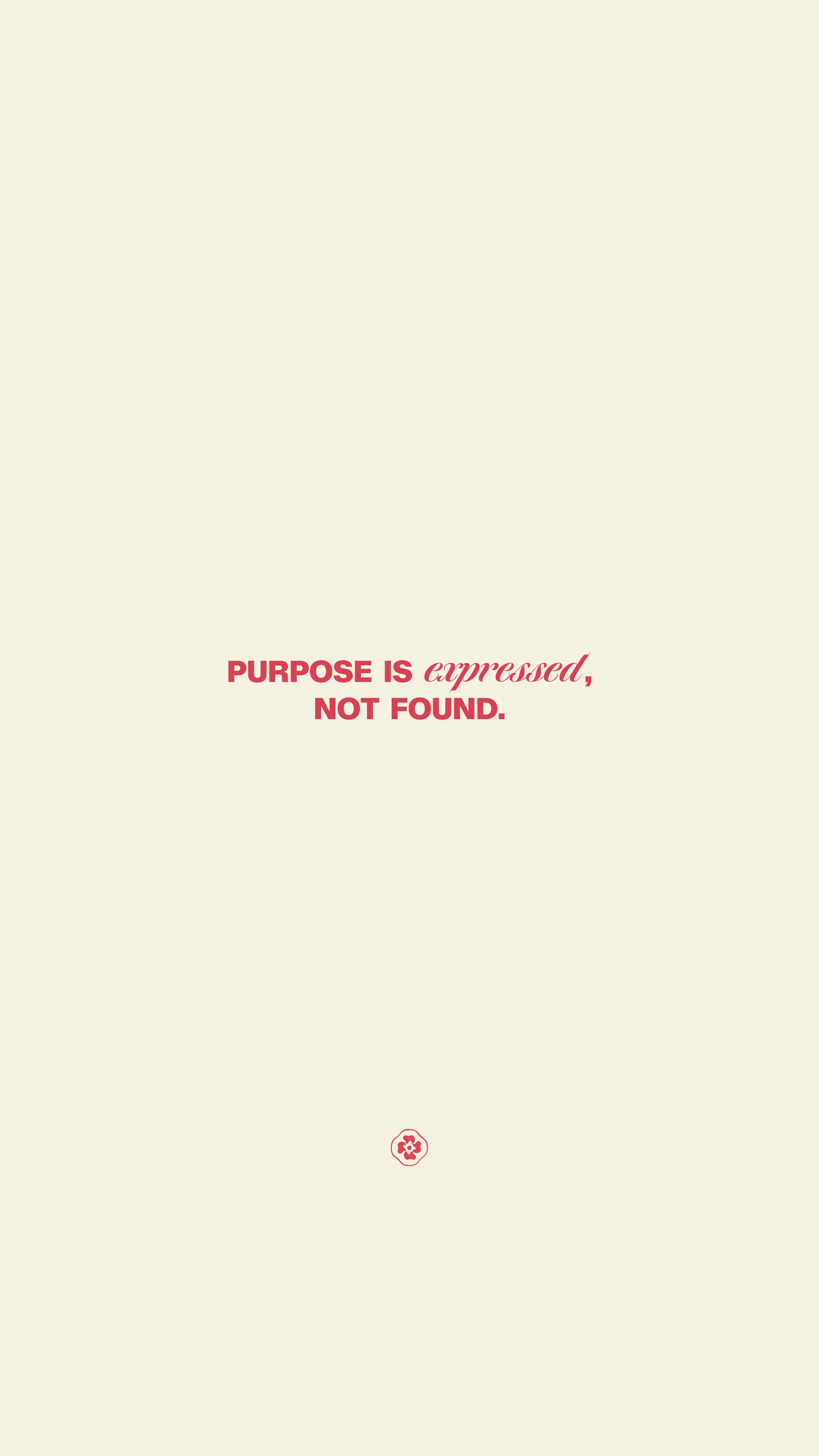
🏛️ purpose is not something you find. purpose is something you express.
through how you live, who you choose to be, what you choose to be useful for, how you show up for the people and situations in front of you.
let me explain. Marcus wrote:
“what is your art? to be a good person.” — Marcus Aurelius
your art is meant in the sense of your craft, your discipline; the thing you've devoted yourself to. and the answer he gave himself is: being a good person.
mind you, it was NOT “to be a great emperor,” “to leave a legacy,” or “to find my calling.” (which i wanted to point out specifically to really let it sink in)
so THAT is the practice; being a good person. that's the vocation, in the original sense.
🏛️ a related stoic concept: oikeiôsis (which we also talked about in the previous issue): natural affiliation, and the expanding concentric circles of care. for the Stoics, becoming a fully developed human meant gradually extending genuine care outward. starting with yourself, then immediate family, then friends, then community, then humanity. so meaning, in this framing, is inherently relational. it lives in your participation in something larger than yourself.
🏛️ another stoic idea: living according to nature. which doesn’t mean follow your bliss or do whatever feels good. what this somewhat cumbersome wording wants to say is to live according to your rational, virtuous self and your role as a social being. meaning comes from doing that consistently, in whatever form your actual life takes.
put all that together and you get something pretty striking:
meaning isn’t gated behind figuring out your “one true calling”. it’s available right now, in your current life, through how you show up.
what this looks like in everyday life
i think a lot of us hear “contribute” and “be useful” and immediately picture changing the world, founding a nonprofit, saving lives. and then we feel completely inadequate bc our actual life is just… work and laundry and trying not to scroll for four hours straight.
so let’s get specific about what meaningful contribution actually looks like in regular life:
🪻 a barista who genuinely cares about the people ordering: they make someone’s morning a little better, every single day
🪻 a parent who’s patient with their kid, and trying even on hard days: that contribution shapes a whole human being
🪻 someone who builds furniture, makes pottery, writes code, illustrates, etc.: creating something that didn’t exist before
🪻 a friend who actually listens and remembers what you said last week
🪻 a teacher, nurse, social worker, therapist: the structurally caring professions, yes
🪻 someone running a small business who treats their customers like humans and not transactions
🪻 someone in an “ordinary” office job who’s the person other people can rely on, who creates a culture of decency around them
and on the virtue side; the meaning that comes from HOW you do anything, regardless of what it is:
🌻 choosing patience when irritation would be easier
🌻 being honest when a lie would smooth things over
🌻 showing up for someone who needs you when you’d rather not deal
🌻 doing your actual work with care instead of just getting through it
🌻 treating service workers with the same respect you’d give your boss
🌻 catching yourself in gossip and redirecting
so meaning lives in two places really: in what you contribute (the visible work, the things you make and give and do) AND in how you do anything (the character expressed through everyday action). you don’t need to save the world to live a meaningful life (!!). you just need to show up well in your lil corner of it. and yes, trying but failing sometimes counts.
🧚 a better question
if “what’s my purpose?” leads most people into a spiral that doesn’t get them anywhere, what’s a better question?
honestly, i think it’s this:
“what do i want to be useful for?”
this one is simpler. more answerable. more actionable. and rooted in contribution rather than self-discovery, which is where the research actually points.
you don’t have to have one big answer. you can have several small ones. and the answer is allowed to change over time. but sitting with that question (and today's tool will help you with answering this as well) tends to be way more clarifying than waiting for a calling to appear.
sth to learn from
Are you searching for purpose?
Then write something, yeah, it might be worthless
Then paint something, and it might be wordless
Pointless curses, nonsense verses
You'll see purpose start to surface— Twenty One Pilots, Kitchen Sink
these lyrics live in my head, honestly. they capture the whole reframe better than i could in a hundred newsletters. you don’t sit around and discover purpose. you write something, paint something, make something, try something, show up for someone… and the meaning slowly surfaces through the action itself.
okay so, i already told you about the lecture hall moment. up until that point, i had been thinking about meaning as something you go out and kind of “accumulate” for yourself: pursue your dream! find your calling! build your perfect life! but as mentioned, the picture he was painting was the opposite. meaning (and the resulting life satisfaction), it turned out, was a byproduct of caring about something other than yourself.
some years later, this insight became the foundation of the thing i’m doing now. building blussomly was the first time i felt like i had real meaning in my life: it's not just a job or a project, but something that genuinely matters, both to me and (i hope) to other people.
and a really important thing to mention about that: i didn’t find blussomly waiting for me somewhere. there was no calling that descended from the sky (i wish lol). i built it. one piece at a time, by paying attention to what i wanted to see more of in the world and slowly creating it.
the meaning of blussomly, for me, has nothing to do with the metrics. nothing to do with followers, sales numbers, or growth charts. those are the visible markers, sure, but they’re not where the meaning, the purpose, lives.
the meaning is in the actual impact: the dms from people saying a newsletter helped them feel less alone, the comments where someone says “for the first time, i feel truly understood”, the messages in my community where a member tells me that the tools and resources i shared fundamentally changed the way they think, feel, and interact with the world (crazy to wrap my head around, btw).
and i’ll be honest with you: i still wobble. like once a month i almost convince myself i should delete all my accounts and start over with a quieter life (guess which week of my cycle this falls into lmao). there are days where i look at what i’m doing and have no idea whether it matters. and then a single message from a follower comes in, and i remember: this matters. even if just for one person, even if i never see most of the people who read this, even if the numbers do whatever they do. it matters.
stoicism gave me a kind of internal direction i didn’t have before. it's a way of orienting that helps me know whether i’m acting like someone i actually want to be. and that orientation, more than any external achievement, is what makes my life feel coherent to me. like there’s a thread running through it. like i’m becoming someone i actually recognize.
which, looking back, is also what coherence is in the research sense. you don’t always need to know exactly where you’re going. you need to be able to recognize yourself in where you’ve been, and where you are, right now.
sth to practice
the usefulness reflection 🐣
this week’s tool is a slow reflection, okay; i don't want you to treat it as a quiz with right or wrong answers. just think about these questions, and answer the ones that resonate.
what kind of impact do i want my existence to have, even in small ways?
in what situations in my current life do i already feel like what i’m doing matters to someone or something? (be specific! what is it, who is it for, why does it feel that way?)
who or what do i naturally show up for, even when nobody asked me to?
what do people consistently come to me for? what do they say i’m good at, good for, good with?
what would i regret not having contributed to or expressed by the end of my life?
where in my current life is there an opportunity to show up with more care, even if the task itself stays the same?
➡️ again, the goal isn’t to leave with a five-year plan or a clear “purpose statement”. this exercise is for noticing where meaning is already available to you, and where you could express more of it through how you’re already living.
💖 and bc this is the soft stoic letter and we don’t do pressure here: this is an ongoing reflection. nobody figures their meaning out in a single sitting. you sit with the questions, you live forward, you notice. that’s the practice.
sth to ask yourself
plenty of reflection prompts in today's tool already, but i know you guys love this section so here’s your journal prompt for this week:
“what would i want people to say about who i was… not what i achieved, but how i showed up?”
sth to save
here’s this week’s reminder. save it as your lockscreen, or keep it in your camera roll for when you need it.
next week, we’re wrapping up the PERMA series with A for accomplishment: effort, mastery, and what the stoics vs. modern hustle culture.
📒 if you want to go deeper on values clarification, finding direction, and building a life that feels meaningfully yours: my digital workbook the stoic girl starter pack has full modules on this exact stuff. grab the workbook here.
🌷 and if you’d like some more guidance on your personal development journey, check out my video course/community here – we work through the whole workbook together. 🤍
until next week,
with love,
luise
M.Sc. Psychology | Founder of Blussomly
website | instagram | tiktok | youtube | email
References:
Grant, A. M. (2007). Relational job design and the motivation to make a prosocial difference. Academy of Management Review, 32(2), 393–417. https://doi.org/10.5465/amr.2007.24351328
Martela, F., & Steger, M. F. (2016). The three meanings of meaning in life: Distinguishing coherence, purpose, and significance. The Journal of Positive Psychology, 11(5), 531–545. https://doi.org/10.1080/17439760.2015.1137623
Mor, N., & Winquist, J. (2002). Self-focused attention and negative affect: A meta-analysis. Psychological Bulletin, 128(4), 638–662. https://doi.org/10.1037/0033-2909.128.4.638
Seligman, M. E. P. (2011). Flourish: A visionary new understanding of happiness and well-being. Free Press.
Steger, M. F., Kashdan, T. B., & Oishi, S. (2008). Being good by doing good: Daily eudaimonic activity and well-being. Journal of Research in Personality, 42(1), 22–42. https://doi.org/10.1016/j.jrp.2007.03.004
Wrzesniewski, A., McCauley, C., Rozin, P., & Schwartz, B. (1997). Jobs, careers, and callings: People’s relations to their work. Journal of Research in Personality, 31(1), 21–33. https://doi.org/10.1006/jrpe.1997.2162
Thank you for this post - I found it so helpful to reframe the question I had been struggling with. I love your work; it is meaningful and beautifully expressed.
thankyouu sm, Luise. this is so helpful. also, as i was reading through this letter, i thought – " your purpose must be blossumly." and then it was. 🥹💗